# the best aproach is to create some kind of constant value for each
# diagonal, you can then use sets to check if something is already there

# for top left to bottom right, row - col
# for bottom left to top right, row + col

_set = set()
neg_diagonal = row - col
if neg_diagonal in _set:
	# that is already in set
else:
	# not already in set
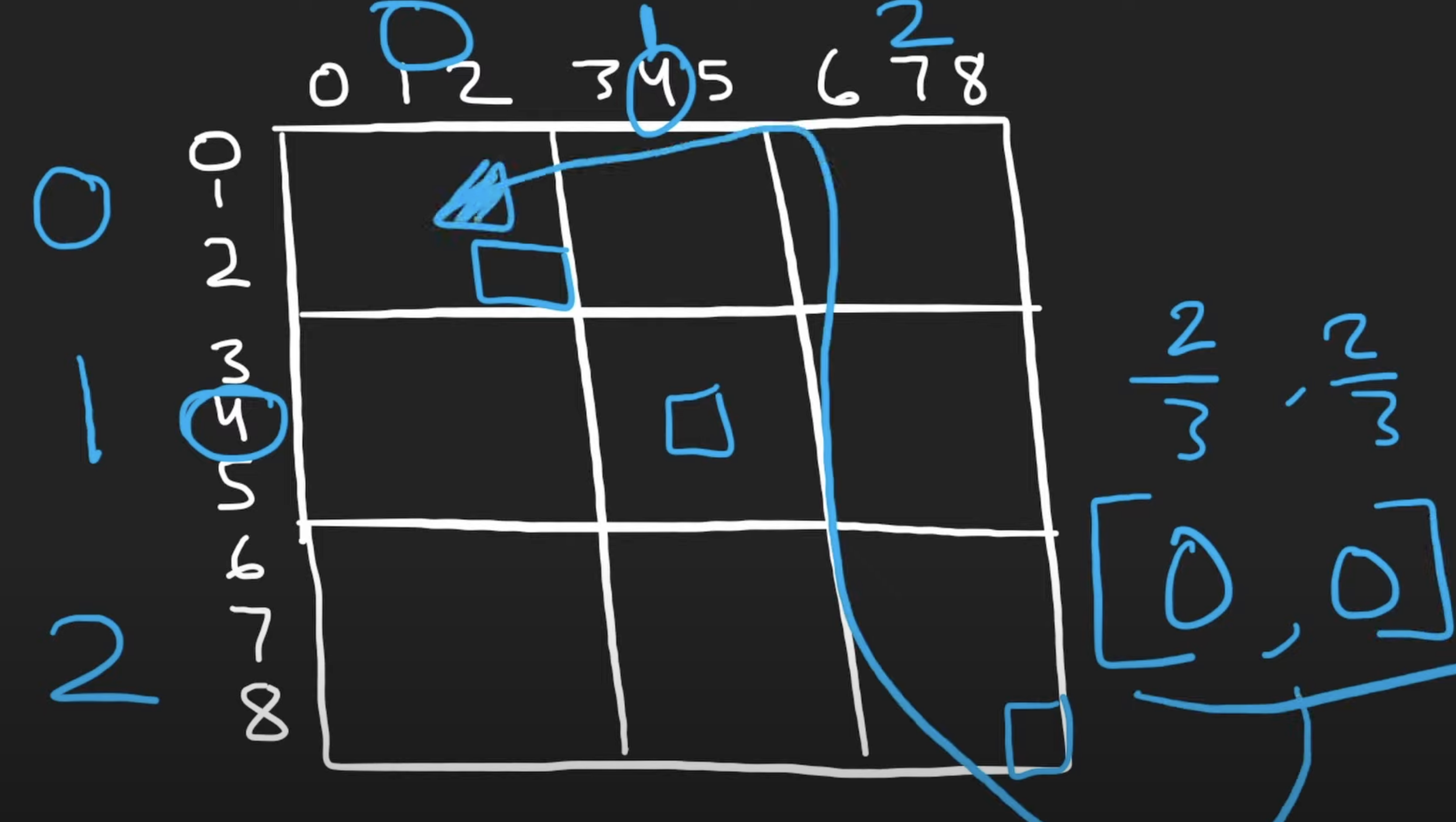
Check groups, aka 3x3 sudoku
# div integers, note ints div to floor

grid = # a 2d array containing the sudoku
square = defaultdict(set) # each square is defined by row / 3 and col / 3

for row in range(9):
	for col in range(9):
		if grid[row][col] in square[(row // 3, col // 3)]:
			# num already in grid
		else:
			square[(row // 3, col // 3)].add(grid[row][col])
Pair aka tuple
pair = (x, y)
pairs_arr = ((x, y) for x, y in zip(og_x, og_y))
pair.sort() # will sort by x
Set
_set = {"apple", "banana", "cherry", False, True, 0}
_set = set() # empty set

if i in _set:
	...

_set.add(1)
_set.remove(1)
Defaultdict
_dict = defaultdict(lambda: False)
# or collections.defaultdict

_dict_with_set = collections.defaultdict(set)

if i in _dict and _dict[i]: # check if item in dict
	...
Heap (key-value)
Queue (FIFO)
Stack (LIFO)
stack = []

x = stack.pop()

stack.append(x)
Linked List
fast and slow pointers
find half way
# in even list, to select right choose head, for left choose head.next
slow, fast = head, head
while fast and fast.next:
	slow = slow.next
	fast = fast.next.next
return slow
find loop
slow, fast = head, head
while fast and fast.next:
	slow = slow.next
	fast = fast.next.next
	if slow == fast:
		return True # loop exists
return False # loop not exists
return head of loop
slow, fast = head, head
while fast and fast.next:
	slow = slow.next
	fast = fast.next.next
	if slow == fast:
		break

if not fast or not fast.next:
	return None # return if no loop

slow2 = head
while slow != slow2:
	slow = slow.next
	slow2 = slow2.next
return slow
stack = [start]
visited = set()

while stack:
  node = stack.pop()

  if node not in visited:
    visited.add(node)

    if node == target:
      return True  # Target found

    for neighbor in graph[node]:
      if neighbor not in visited:
        stack.append(neighbor)

return False
BFS
queue = deque([start])
visited = set()

while queue:
    node = queue.popleft()

    if node not in visited:
        visited.add(node)

        if node == target:
            return True

        for neighbor in graph[node]:
            if neighbor not in visited:
                queue.append(neighbor)

return False
Backtracking
def backtracking(val):
	if # met some condition):
		return True

	result = False

	for i in range(n): # or look at nayboars
		# do some checks

		result = backtracking(val) or result

	return result
Bubble sort
for i from 1 to N
	for j from 0 to N-1
		if a[j] > a[j + 1]
			swap(a[j], a[j + 1])
Insertion sort
for i from 1 to length(arr) - 1
	j = 1
	while j > 0 and arr[j-1] > arr[j]
		swap(arr[j-1], arr[j])
		j = j - 1