Introduction to network
Basics
what is a network?
A network is two or more computers with the ability to exchange data, with the use of networking technologies.
what is data?
Data is information in the form of characters, quantities or symbols that can be stored, processed or exchanged between computers.
Network sizes
What is a WAN
Wide area network - this is typically a collection of LANs, with inter-lan connections
What is a LAN
Local area network - these are networks in a local geographic location
What is a PAN
Personal area network - these are networks that are typically connected over bluetooth
What is fog computing?
This is when computers at the physical edge of a network are used to do processing
What is a mirror?
This is a server that is an exact copy of another that is located in a different geographical location with the goal to provide faster service
Transfer of data in a network
How would data be transferred between a pc and a printer over a cable?
- ASCII is stored as 8bit (bytes) in magnetic memory
- The ASCII text would then be converted from a magnetic medium to a electrical signal
- These bytes are then transmitted by the computer over the cable to the printer
- The printer will then assemble the bytes and interpreted as ASCII
- The data is then stored in the printers memory ready to be processed
Protocol
Define protocol?
This is a pre defined set of rules that governs the transmission of data between devices
Give an example of why you might need a protocol
When sending out data you might read the bits from left to right 0010 1101
When receiving this data you might read the bits from right to left 1011 0100
A protocol would make it so that both devices would agree on a why to interpret the bits
Arpanet
What is Arpanet?
This was the first computer network in the USA
When was it made?
1969
How much did it cost?
$400k or $2.4M today
How much data could it store?
192 Kilo bytes
Topologies
What to look out for as far as pros and cons are concerned
- Scalability
- Complexity
- Reliablity
- Speed
- Price
Ring
Draw the topology

pros
- They tend to be unidirectional, which means less chance for data collisions
- They can also be bidirectional
- Easily expandable
- Data packets stay intact, so very reliable
- Simple design
- Is ok if one node breaks
cons
- Tend to be very slow
- If more then one node breaks the whole network gets divided
- Very expensive
- Adding an extra node will disrupt the entire network
Mesh
Draw the topology
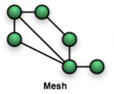
pros
- Very scalable, with no dispution
- Very reliable
cons
- Heavy workload, since each node must act like a router
- Complicated to setup
- Increased Energy consumption, due to the increase in workload
- Expensive
Star
Draw the topology

pros
- Easy to setup
- If a node breaks there is no disruption
- Easily scalable
cons
- The switch is a single point of failure
- More cable length than a linear network
- More expensive than a linear network
Fully connected or Full Mesh
Draw the topology

pros
- Very reliable
- Maintenance wont cause disruption
cons
- VERY expensive
- The larger the network the less scalable it becomes
Line
Draw the topology

pros
- VERY cheap
- Easily scalable
- Good for small networks
cons
- Not reliable
- Low poor data transfer speeds
Tree
Draw the topology
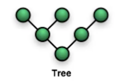
pros
- Scalable
- Easy to find errors
cons
- If a parent node breaks, it cuts off access to the rest of the network
- Salability relies on type of cable used
Bus
Draw the topology

pros
- Cheap
- Scalable
cons
- One point of failure
- Slow
- Bad for security
Network media
Optical cable
How is the data transmitted?
Optical signals are beamed down the cable
How fast is the signal propagation speed?
60% of C
pros
- Very fast
cons
- Expensive
Copper cable
How is the data transmitted?
Electrical signals down a copper cable
Define cable
A cable is a bunch of wires grouped together
pros
- Cheap
cons
- Slow
Wireless
How is the data transmitted?
Electromagnetic signals
pros
- Easy to use
cons
- Typically very slow